ABOUT THE GRANT
Krabbe disease (KD), also known as Globoid cell leukodystrophy, is a severe neurodegenerative lysosomal storage disorder characterized
by mutations in the GALC gene. This leads to the toxic accumulation of psychosine most commonly resulting in early infantile KD, which
is typically fatal by age two. Currently, hematopoietic stem cell transplant (HSCT) is the standard treatment, but it only partially alleviates the
disease. The mechanisms behind how HSCT mitigates KD pathology are not yet fully understood, highlighting a significant gap in our knowledge.
To address this gap, we have employed a novel conditional Galc knockout mouse model to dissect the specific roles of GALC deficiency in the various
cell types of the CNS, and to understand their contributions resulting in the pathogenesis of Krabbe disease. Our previous research has revealed that
the knockout of Galc in oligodendrocytes (OLs) is both necessary and sufficient to induce a KD like phenotype. Leveraging Translating Ribosome
Affinity Purification (TRAP) technology, we isolated ribosomes from affected oligodendrocytes in this model and conducted RNA sequencing analysis,
which identified GALC deficiency-related transcript alterations. Intriguingly, in silico Ingenuity Pathway analysis suggested a strong correlation of our
TRAP-seq gene targets to be influenced by the inflammatory transcriptional regulator NFκB. Preliminary in vitro analysis of Galc-KO OL precursor
cells (OPCs) presented an increased activation of the canonical NFκB pathway compared to GALC-sufficient OPCs. Additionally, inhibiting NFκB activation
in vitro abolished the premature cell death phenotype observed in Galc-KO OLs and enhanced their differentiation. Based on these findings, we
hypothesize that GALC deficiency in OLs activates NFκB signaling, leading to cell death and neuroinflammation through the secretion of proinflammatory
factors. To test this hypothesis, in Specific Aim 1 we propose to characterize a mouse model inhibiting the canonical NFκB signaling in OLs within a
global KD mouse model. This will allow us to assess the impact of NFκB ablation on survival, myelin morphology, neuroinflammation, and conduct
scRNA-seq analysis to understand the molecular mechanisms promoting pathology associated with NFκB activation in OLs. In Specific Aim 2,
we will evaluate the efficacy of various NFκB pathway inhibitors in reducing the dysfunction present in Galc-KO OLs in vitro. These studies seek to
determine if targeting NFκB could offer a promising therapeutic avenue for KD. Furthermore, they will investigate the intriguing concept of OLs as
regulators of neuroinflammation, a relatively recent but increasingly significant idea in the field. This research has the potential to address critical
questions on detailed mechanisms of neuroinflammatory and demyelinating diseases.
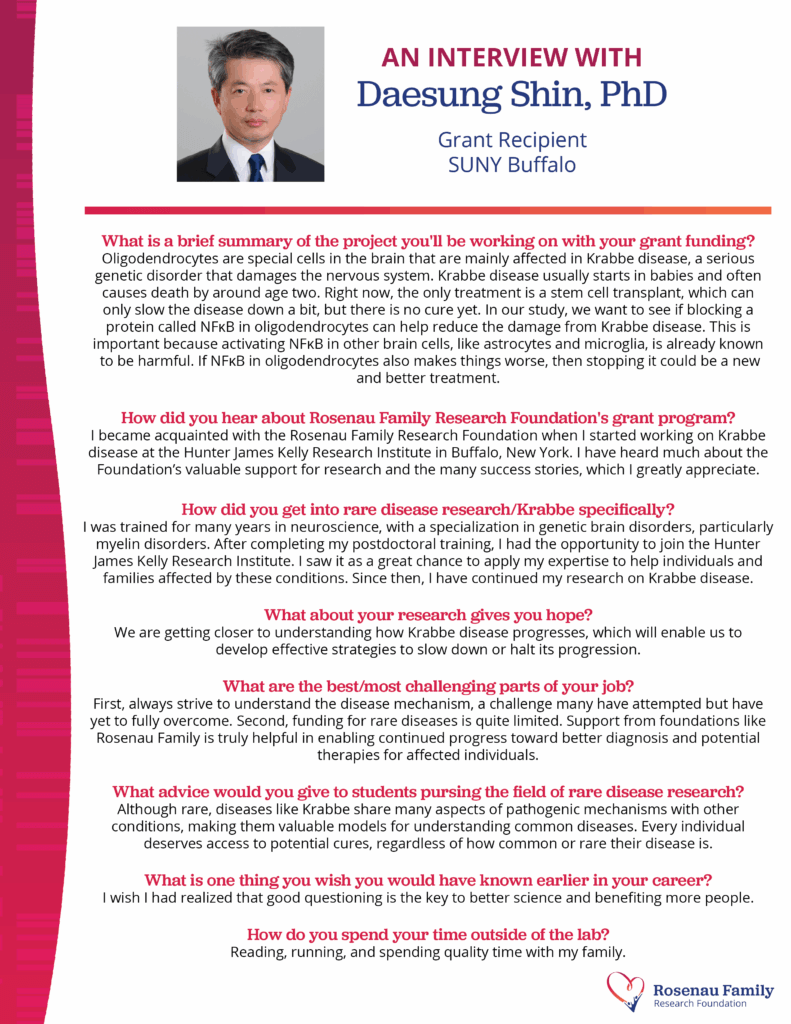
ABOUT DR. SHIN
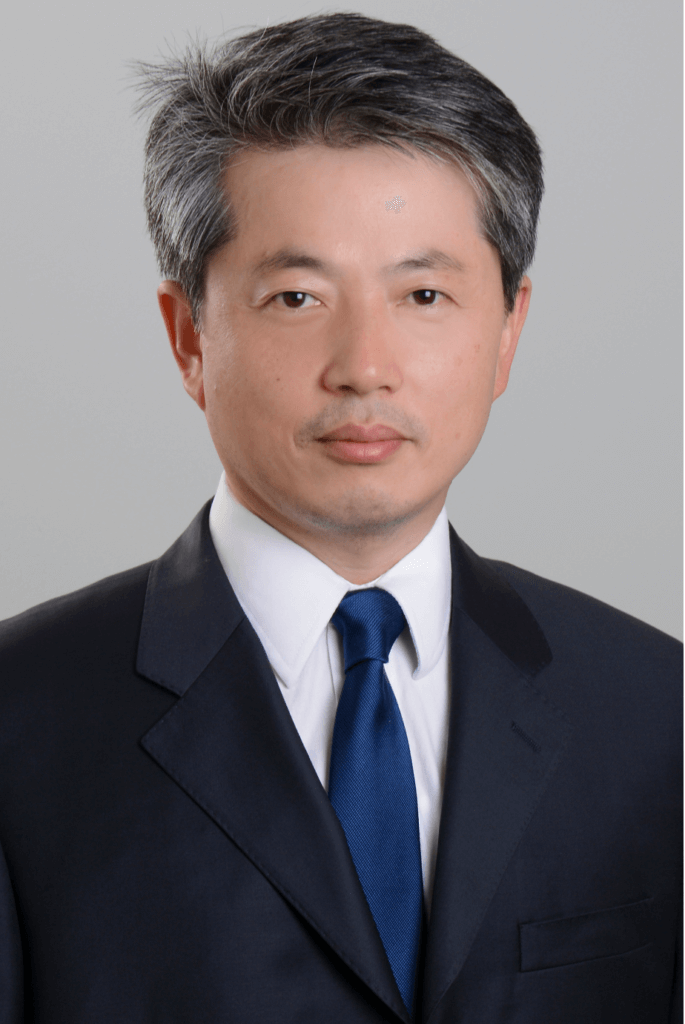
Dr. Daesung Shin is an Assistant Professor in the Department of Biotechnical and Clinical Laboratory Sciences at the Jacobs School of Medicine and Biomedical Sciences – University at Buffalo (SUNY Buffalo). Previously, he worked as a senior scientist in the Institute for Myelin and Glia Exploration (formerly the Hunter James Kelly Research Institute), which is dedicated to studying brain cells in the nervous system and finding therapies for diseases of myelin such as Krabbe disease. Dr. Shin is actively working on a research program on the role of GALC in Krabbe disease. He has created the first conditional Galc knockout Krabbe mouse (Weinstock et al., Nat. Comm., 2020). As a neuroscientist, he has successfully administered many projects, collaborated with other researchers, and produced peer-reviewed publications from each project he worked on. His postdoctoral training was done in the neurogenetics lab under Drs. Louis Ptacek and Ying-Hui Fu at the University of California San Francisco, where he carried out a mechanistic study on demyelinating neurodegeneration using various conditional knockout mouse models and purified brain cells/RNAi-mediated knockdown. Dr. Shin earned his doctoral degree from the Korea Advanced Institute of Science and Technology.